
Find a Doctor
Designing a patient-to-provider matching experience from scratch, end to end, for a healthcare platform that needed both a new feature and a new brand foundation.
Impact
Overview
At BORN Group, I designed the entire Find a Doctor experience for CareAllies' public-facing platform. This feature did not exist before the engagement. I took it from blank canvas through wireframes and into production-ready visual design, covering the full patient journey: search entry, results and filtering, interactive map integration, provider profiles, and error states.
The engagement also included updating CareAllies' brand guidelines and building a component library to support consistency across the platform. Working closely with CareAllies stakeholders and business analysts, I kept the design grounded in real data constraints, surfacing back-end limitations early enough to shape design decisions rather than discover them at handoff.
The feature launched across desktop and mobile in 2024.
Problem
Find a Doctor users had no effective way to search for local care providers on the platform. The existing experience lacked the tooling, interactivity, and brand coherence needed to drive engagement and trust.
Solution
A comprehensive Find a Doctor experience designed end to end: search, results, filtering, interactive map integration, provider profiles, and error states. Paired with an updated component library and refreshed brand guidelines to bring consistency and polish across all platform surfaces.
Connect Patients and Doctors
Create an intuitive, effective tool for users to find doctors and facilities within their area, reducing friction in the care-seeking journey and increasing platform engagement.
Integrate Back-End Data Reliably
Ensure that back-end data sources could be effectively captured and rendered on the front end, creating a search experience users could trust to return accurate, complete results.
Elevate the Brand
Enhance CareAllies' existing brand guidelines and build a comprehensive component library to bring visual consistency and credibility to the full experience across all surfaces.
I designed wireframes to guide users through entering their search criteria, refining results, and selecting a provider, including error states and no-results scenarios. The wireframe process served two purposes: establishing the interaction architecture and giving stakeholders and business analysts an early artifact to validate data requirements against.
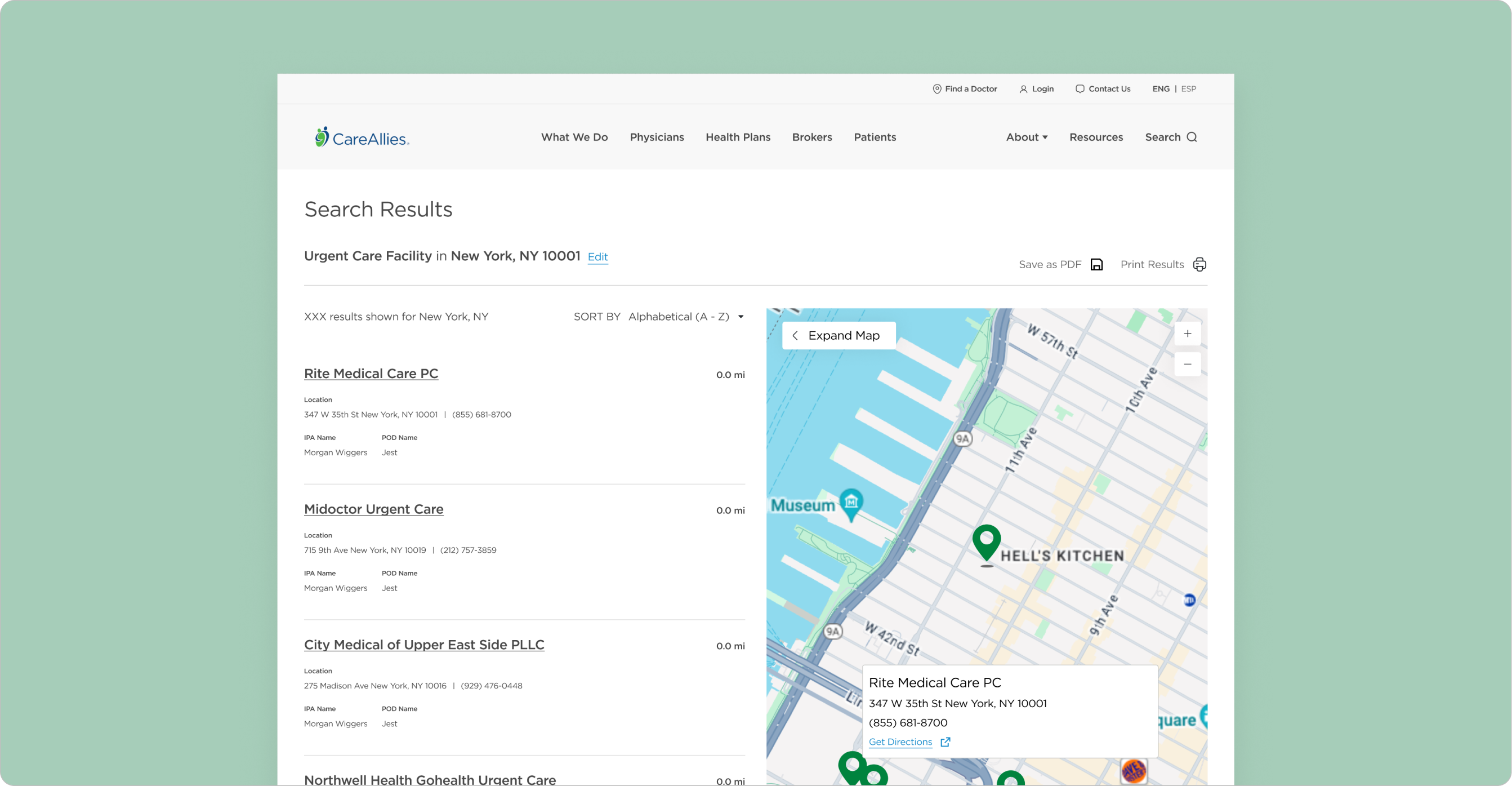
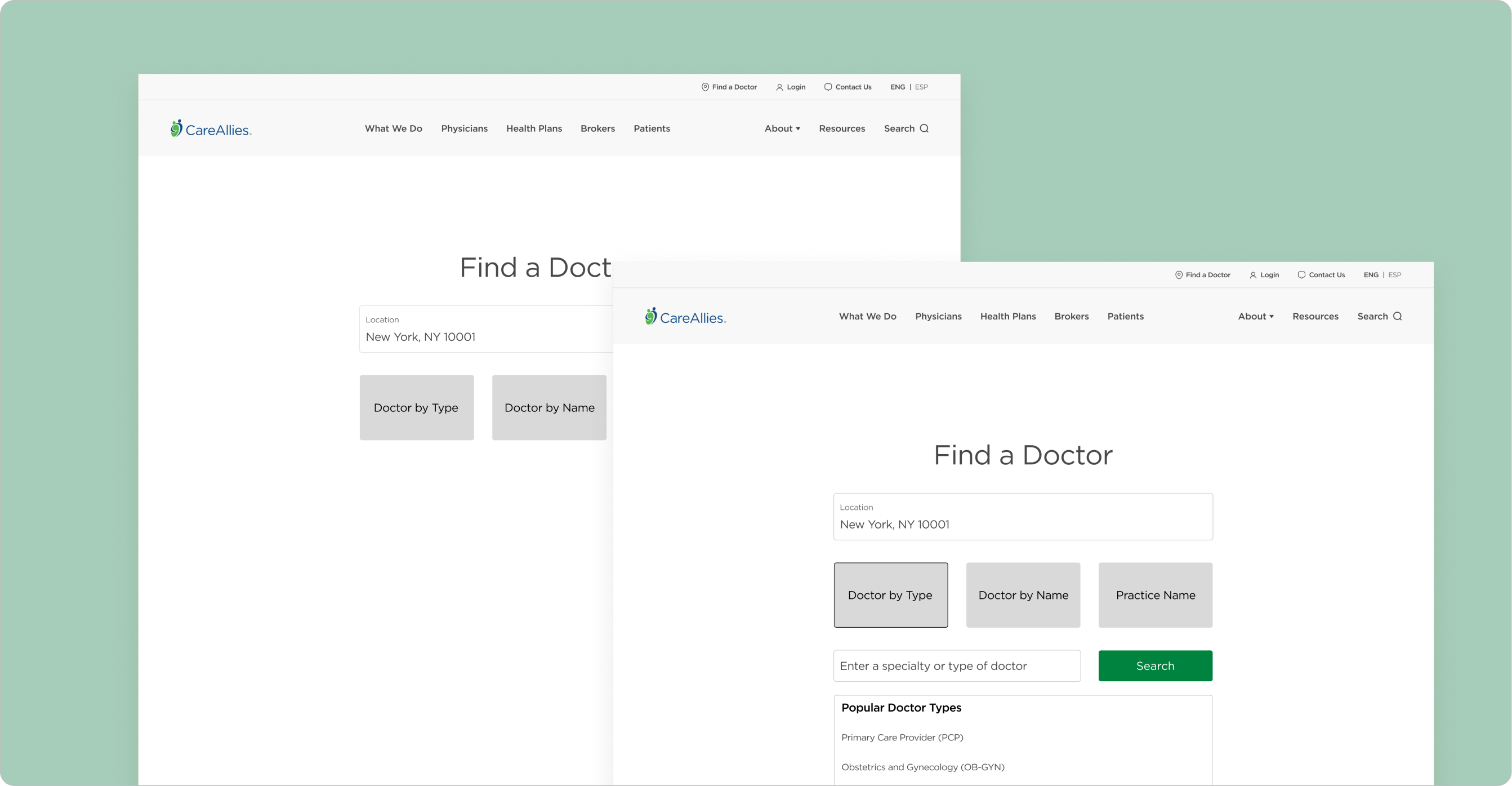
Working directly with CareAllies stakeholders and business analysts, I gathered requirements iteratively and designed an interface that was both easy to use and technically feasible given the data available. Map integration was a particular focus: the interactive map needed to feel seamless with the list view, allowing users to locate doctors geographically without disrupting their search flow.
Error states and empty states were designed with the same care as the primary flow, because in healthcare, a failed search is not just a UX problem.
Here's the final experience in action. The flow covered search entry, results, map interaction, and provider selection, and launched across desktop and mobile in early 2024.
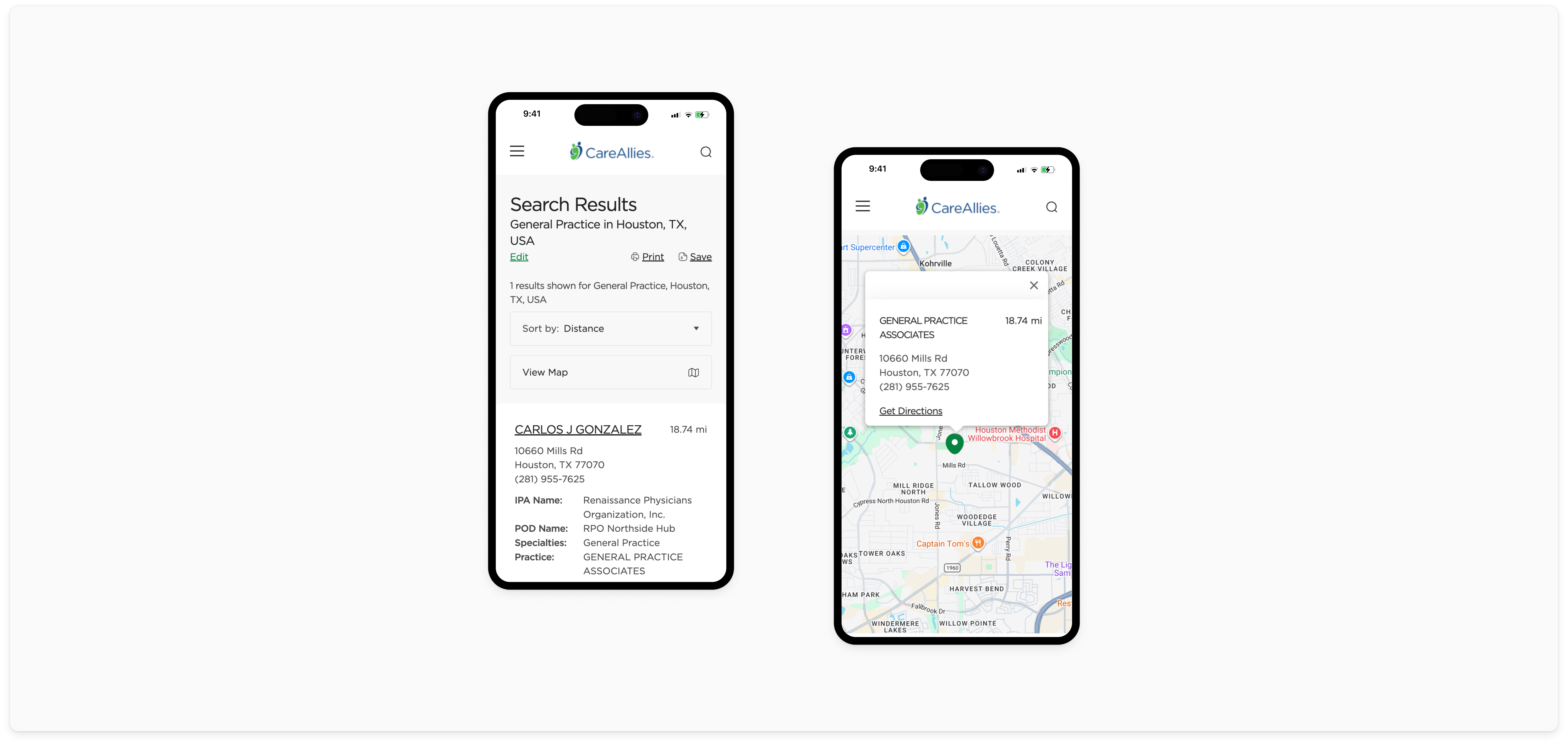
Designing a Find a Doctor experience surfaced challenges specific to healthcare: the stakes of a failed search are higher than in most product contexts, and users need to trust the platform before they trust a provider recommendation. Design consistency is not just an aesthetic concern here. It is a meaningful part of building that trust.
What went well
Close collaboration with CareAllies stakeholders and business analysts meant the design stayed grounded in real requirements throughout. The wireframe-to-visual-design process moved efficiently because the requirements were well understood before high-fidelity work began.
What could have been improved
Earlier investment in data source mapping would have shaped several design decisions sooner. Some constraints around what provider information was actually available from the back end surfaced later than they should have, requiring adjustments that earlier discovery would have prevented.